Sunday, August 31, 2008

Rasoul Sadr Ameli

EVERY NIGHT, LONELINESS (2008)


=========================
The film is the story of Atiyeh, a young radio show host specializing on "relationships", who is suffering a terminal illness and will die in 4 months, unless she agrees to a risky surgery (which she refuses to have).
Her desperate husband brings her on a pilgrimage to Mashad. She is not a believer, but she becomes overwhelmed by the power of other's faith, and recognizes in her the love for ...

A Marvelous film, about belief, faith, pain, death, love, life ... shot against the rarely seen backdrop of Imam Reza's Shrine in Mashad.

=========================
By: Rasoul Sadrameli
Born in Isfahan, Iran in 1953, Rasoul Sadrameli studied sociology in France before returning to Iran to produce Ami Ghavidel's RAIN OF BLOOD (1981) and make his directorial debut with THE RELEASE (1982). He has since directed THE CHRYSANTHEMUMS (1983), PAIZAN (1987), THE VICTIM (1991), TEHRAN SYMPHONY (1993), THE GIRL IN THE SNEAKERS (1999), I'M TARANEH, 15 (2002) and DISHAB BABATO DIDAM, AIDA(2005).

Sadr Ameli is a post-revolutionary director, who opened the peri-war Iranian cinema to "love" stories: In "golhaye Davoodi" (THE CHRYSANTHEMUMS (1985)).

Leila Hatami is great in her role. (The great Iranian director, Ali Hatami first cast his daughter in Delshodegan, where she played the role of a blind Turk princess, wandering in a rose garden in search of her Persian singer. Ever since, Leila Hatami has played in numerous films, often type cast as an elegantly eccentric woman in 'search' of something lost ... and she plays her type WELL.)

I loved the poetry (Death of Swan By Hamidi, plus a lot of Hafiz).

The colours were vivid: the golden shrine, decorated with blue ceramics and glittering mirrors, marble mosaics, ruby red Persian rugs (source of pictures above!).

Of course the music by Mohammad-Reza Aligholi was another highlight of this wonderful two hours spent on passion, reflection and interospection.

AND ... this movie was made by assistance from a Mullah, which made me chuckle as i saw the titles, but then I came to realize that without the assistance of the "Hojat El-Eslam", no camera would have gained permission to go to the pilgrimage site. In fact the only other times I have seen the Imam-Reza Shrine on celluloid has been in Baraka, and in the last episode of Pasolini's, Trilogy of Life!

And this, to me, "is" velvet REVOLUTION
... Americans, Monarchists and the MKO:
HANDS OFF OF IRAN!


Let our artists do their job: Persian Renaissance!

Thursday, August 28, 2008

Susa

This is Susa, one of the oldest-known settlements of the world, dating back to 8000 BC.

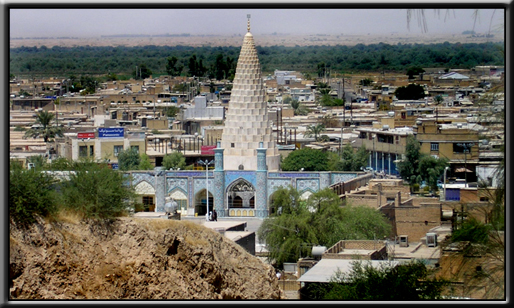
Susa is mentioned in the Ketuvim of the Hebrew Bible, mainly in Esther, but also once each in Nehemiah and Daniel. Both Daniel and Nehemiah lived in Susa during the Babylonian captivity of Judah of the 6th century BCE. Esther became queen there, and saved the Jews from genocide. A tomb presumed to be that of Daniel is located in the area, known as Shush-Daniel. The tomb is marked by an unusual white, stone cone, which is neither regular nor symmetric. Many scholars believe it was at one point a Star of David. (Picture on bottom right)

Susa is further mentioned in the Book of Jubilees (8:21 & 9:2) as one of the places within the inheritance of Shem and his eldest son Elam; and in 8:1, "Susan" is also named as the son (or daughter, in some translations) of Elam.

Shushtar's Historical Hydraulic System is a UNESCO world heritage site (picture on top).

The main components of the hydraulic systems are:

  • The canal called Ab-e Gargar (or the medieval Mashreqân) which is led from the left bank of the river about 500 m north of the town; it runs southwards along the east side of the cliffs of Shushtar and rejoins the Kârun at Band-e Qir;
  • The great barrage called Band-e Qaysar (the Dike of Caesar) also known as Band-e Mizân, which is thrown across the principal arm of the river (here called Shoteit) east of the town and is about 350 m long; this barrage supports a bridge that connected the town with the west bank, but now a considerable gap is broken in it;
  • The canal called Miyânâb which begins above the barrage in the form of a tunnel cut out of the rock on the western side of the town; the Miyânâb turns southwards and irrigates the land south of the town.

The waterworks in Susa were developed to deliver water to the city from the river Kârun, located 10 meters below. The main aim of these constructions was to meet the inhabitants' needs for protecting themselves from floods, while irrigating their agricultural lands and making possible passages across the river and canals. The construction of bridges, dams, bridge-Dams, mills, qanâts, reservoirs, tunnels, and canals for the water supply of the town were conducted in the Sâssanian period (224-650 A.D.), especially during the reign of Shapur I (r. 240-272 A.D.).

For a touristic view of the region: see this.
=================
Encyclopedia Britanica:
Susa, ancient city, Iran also called Shushan, Greek Susiane, modern Shush.

Capital of Elam (Susiana) and administrative capital of the Achaemenian king Darius I and his successors from 522 bc. It was located at the foot of the Zagros Mountains near the bank of the Karkheh Kūr (Choaspes) River in the Khuzistan region of Iran.

The archaeological site, identified in 1850 by W.K. Loftus, consists of four mounds. One held the citadel and was excavated (1897–1908) by Jacques de Morgan, who uncovered, among other objects, the obelisk of the Akkadian king Manishtusu, the stele of his successor Naram-Sin, and the code of Hammurabi of Babylon. A second mound to the east was the location of the palace of Darius I and was excavated (c. 1881) by Marcel Dieulafoy. A third mound to the south contained the royal Elamite city, while the fourth mound consisted of the poorer houses.

The finest pottery was found in the lowest strata and belonged to two different civilizations, both Neolithic. Above the early strata were remains of Elamite and early Babylonian civilizations. In the upper portions of the mounds Achaemenian, Greek, Elamite, Parthian, and Sāsānian remains were found. Until sometime after the 14th century ad the city was a flourishing centre of a district known for silk, sugarcane, and oranges.

Citations

MLA Style:

"Susa." Encyclopædia Britannica. 2008. Encyclopædia Britannica Online. 28 Aug. 2008 <http://www.britannica.com/EBchecked/topic/575503/Susa>.


Sunday, August 24, 2008

Tribute to Khosro Shakibai

I JUST learned about the death of an actor whose star in Hamoun will outshine the short meteor of his life.

If you don't know Khosro Shakibai and what he was to the Iranian cinema, then think of him as what

Marcello Mastroianni was to the Italian one
Jeremy Irons is to the British one
Bruno Ganz to the German Cinema
Gerard Depardieu to the French Cinema
Toshiro Mifune to the Japanese cinema
Humphrey Bogart to the American cinema

Shakibai (or shakibayee) WAS the face of Iran's National Cinema after the war.

The following films are perhaps available in your upper-scale video club:
Hamoun , (1990)
Banoo (1995)
The mix (2000)

...
and I am noticing IMDB is missing a number of his films ...
I am happy I didn't learn about his death on my Birthday ...
Now I am quite s.a.d ...

Saturday, August 23, 2008

Iran, Georgia, Russia

I know I am over due in providing an Iranian perspective on the Russian/US stand off, which has GREAT implications for Iran. But, luckily someone else has said what I had to (emphasis is mine):

IRAN: US-RUSSIAN TENSION CREATES NEW DIPLOMATIC OPTIONS FOR TEHRAN
(Naj: Not necessarily though)
Kamal Nazer Yasin 8/22/08

The ongoing crisis in the Caucasus, sparked by Russia’s incursion into Georgia, can open new diplomatic opportunities for Iran. Officials in Tehran are currently treading cautiously, however, keeping their options open as they seek to maximize the benefits of renewed confrontation between the United States and Russia.

Conventional wisdom holds that the breakdown in US-Russian relations could bring immediate benefits for Iran’s nuclear program. Given the fallout over Georgia, many US experts believe Russia will now obstruct American-led efforts in the UN Security Council to expand sanctions against Iran that aim to pressure Tehran into giving up its nuclear aspirations.

But
while Iranian officials certainly would like to see Russia veto any proposal to tighten the sanctions regime, they are not counting on Moscow to do so. Iranian experts say Russia in the past has proven to be a fickle friend. Thus, many in Tehran do not believe the Kremlin’s policy on the Iranian nuclear issue is necessarily linked to the twists and turns of US-Russian ties. While Moscow may be intent on tweaking Washington, Russian leaders may still see it as in their best interests to maintain solidarity with the other members of the so-called 5+1 group, comprising the five permanent UN Security Council members and Germany. [For background see the Eurasia Insight archive].

Russia, in any event, cannot be considered an inveterate friend of Iran. In several notable instances, in particular in the ongoing process on the territorial division of the Caspian Sea, the Kremlin has acted more like an enemy than an ally of Iran. [For background see the Eurasia Insight archive]. "Relations between Iran and Russia can best be described as a ‘marriage of convenience," said one Tehran political scientist, who spoke on condition of anonymity.

The partnership has never been one of equals. For the past three decades, Iran has been dependent on Russia -- for diplomatic support, arms sales and technological assistance in the nuclear sphere. "Iranian leaders are aware of it [the dependency] and they resent it, but there was very little they could do about it," said the Tehran political scientist.

Iran’s wariness of Russia’s commitment to the bilateral relationship is reflected to Tehran’s studied silence when it comes to the Caucasus crisis. In sharp contrast to other perceived friends of Russia -- in particular Syrian leader Bashar al-Assad, who voiced full support for Russia’s military action in Georgia, then inked an arms deal in Sochi -- Iran has refrained from taking sides in the Caucasus conflict. [Naj: Iran has good reasons for staying silent: 1) Iran cannot condemn Georgia because Iran's dealing with her own secessionists and would be dealing with them heavy-handedly as Georgia did. 2) Iran cannot condemn Russia because Russia's weakening the Americans, which is what Iran really needs now. 3) Iran cannot support Russia because it is a foreign invasion in the name of "human rights and democracy" which mirrors America's action in Iraq. 4) Iran cannot support Georgia because Georgia's is sucking up to the US! So Iran is doing what is always does during WW-like conflicts: remain silent and neutral]

The Iranian Foreign Ministry adopted a decidedly neutral tone when addressing the Russian-Georgian conflict, resorting to diplomatic platitudes that countries use when they don’t want to commit themselves. Foreign Ministry spokesman
Hassan Qashqavi stated simply at an August 12 briefing that Tehran was "following current developments in the Caucasus and urge[s] the belligerent parties to resolve their disputes through peaceful means."

Since then, Iranian officials have uttered nary a word about the conflict. The low-profile approach seems to indicate that pragmatists in Tehran have control of the foreign policy wheel. Iranian
neo-conservatives who are loyal to President Mahmoud Ahmadinejad have voiced discontent with Tehran’s current policy. "Our reticence only aids the camp that wishes US regional adversaries to remain silent while US supporters come to the support of [Georgian President Mikheil] Saakashvili," noted an August 16 commentary published in Kayhan, a newspaper that is strongly supportive of Ahmadinejad.

Experts in Tehran believe the Iran’s foreign policy establishment is playing a waiting game in the expectation that deepening US-Russian acrimony will open up new diplomatic avenues that Tehran can use to end its international diplomatic isolation. "A whole new set of options may be opening up for Iran," said an Iran-based expert.

According to some prominent US experts, Iran’s strategic assessment of the situation is sound -- the United States and Russia appear headed for a period of prolonged hostility. "This war [in Georgia] was an early sign of escalating Russian assertiveness" in the Caspian Basin, said Gail Lapidus, a regional expert at Stanford University’s Institute for International Studies. Lapidus added that NATO members will likely feel compelled to take counter-measures to check Kremlin attempts to reassert Russia’s influence in the former Soviet sphere.

From Tehran’s perspective, creating new opportunities requires leverage, and the only way to obtain it is if Iran can play Russia against the United States and European Union, or vice versa. Currently -- with the Bush administration in power in Washington, and Ahmadinejad occupying the Iranian presidency -- few in Tehran are under any illusions that Iran can engage in substantive cooperation with the United States in the near term. But some experts and officials believe that present circumstances, especially given the US-Russian acrimony, could change quickly.

"
Iran’s rather neutral stance on the [Caucasus] can be read as a signal to the United States," said the Tehran political scientist. Many in Iran’s foreign policy establishment remain interested in trying to restore diplomatic relations with the United States, which would open up the possibility of Iran serving as a major conduit for funneling Caspian Basin energy westward. The fighting in Georgia has exposed the vulnerability of the Baku-Tbilisi-Ceyhan pipeline and other routes. [For background see the Eurasia Insight archive].

"
If the United States was to open an interest section in Iran, perhaps neighboring countries [such as Turkmenistan] would see this as the start of a thaw in US-Iranian relations -- the real opening they are waiting for in order to boost their trade or oil and gas shipments [via Iran]," said a European-based energy analyst, who spoke on condition of anonymity.

Of course, there are numerous obstacles that currently impede a normalization of relations between the United States and Iran. But Iran could at least gain leverage with Russia if it can create the appearance that a rapprochement between Tehran and Washington is possible.

In doing so, Iranian officials would be looking to coax Moscow into following through on numerous commitments, such as completing the
Bushehr nuclear power plant and selling advanced anti-aircraft missiles to Iran. Tehran could also possibly use the US-Russian tension to try to break down Russian and Chinese opposition to admitting Iran into the Shanghai Cooperation Organization.

Editor’s Note: Kamal Nazer Yasin is a pseudonym for a freelance journalist specializing in Iranian affairs.
=============================
Trivia:

Gerogia was an Iranian state, taken away by the Russians some 200 years ago

Iran supplied fuel to US-backed Georgia in 2006 when Russia cut them off gas supplies
Fossil fuel energy is not the only form of energy offered to Georgia

Sunday, August 17, 2008

Woohoooo I get an award


DivaJood has bestowed me with the kick-ass blogger award :)

And this is the first time anyone has given me an award. And to get this award from DivaJood, an American(/Israeli) artist, who blogs for peace, and who--according to herself--doesn't see eye to eye with me, means even more.

To get this award is making me reflect a bit on the objective of the "Neo-Resistance". I started blogging in November 2006. The threat of war on Iran had begun to look eminent. The media was full of disinformation. People, who assumed themselves intellectuals had started noticing there was a place called Iran on the map. And Iran was becoming the buzz word of cocktail parties. What intrigued me to blog, was some German neuropsychologist, with self-assumed 'global' aspirations asking me: "so, In Iran, could you go to University?"

I was about to scream: "not only we do, but also our universities teach us well enough to not think/assume that in Germany everyone is still a Nazi."

I held my tongue, but came to blog the same evening.

I decided to do a counter-propagandist blog. To take the same buzz words used by CNN, and to use it in favor of my country and its ill-known people, culture, history. And this, I have been doing against the burden of life, against tragedies i have and am going through, and against my lack of proficiency in English language.
And, more importantly, I have been empowered in my struggle to blog, by every single one of your comments, your critics, your encouragements, and your enthusiasm to have learned something new about an old place in our world; about Iran.

These days I am busy; and I am in a state of hibernation with respect to Iran events. I also have limited access to internet; on my own decision. But, I am grateful to DivaJood for this gesture of appreciation, and keeping me on my toes, and letting me know that I may have been making a little difference, for peace, for justice, for human dignity.

I must pass on the torch to 5 other bloggers. These, wonderful men and women, inspire me, inform me and entertain me. My list is missing ALL those who are in my blogroll. I don't blogroll anyone who is not an ass-kicker!

Here, my selection criteria is just based on the most recent statistics of bloggers with whom I have communicated.

Marc: Adored by Hordes
Pedestrian: Sidewalk Lyrics
Brother Tim: Of Revelation
Sophia: Les Politiques
Rick: Ten Percent

Saturday, August 16, 2008

Simin in Los Angeles (December, 1952)

Previously:
Stanford Village (Simin's letters 1952-3)
Eisenhower's role in 1953 (Simin's letters: Stanford Village 1951-52)
Simin and Jalal

I december 1952, Simin pays a visit to LA with the hope to meet a producer who might show an interest in some of her or her husband's work; but with the objective of learning about theater and cinema in America. Here are some of her impressions of Los Angeles and Hollywood.

page 206-207:
"yesterday, we left Stanford at 7:30, heading to Paolo Altos, and then off to LA on the highway ... We had fun, because the road was very smooth and the landscapes magnificent. The ocean on the right, pacific; and the woods on the left, palm, redwood, pine, oak and trees I don't even know their names. It had just rained. Air was clear and a mild sunshine. Weather like heaven and scenery enchanting. Some of the hills were covered with trees, others with just grass. The sea changed color; and the empty beach houses, laying around like a doll house. Completely uninhabited. Even a bird didn't fly. These were the vacation homes of the Hollywood stars. Trust me, this part of California is like a fairy town ... the entire 400 miles of road between Stanford and LA crossed through beautiful towns. We passed through San Jose, Santa Maria, Salinas (which you have read in Steinbeck), Santa Fresco and Santa Barbara. All were beautiful and magnificent. All had schools, churrches, excellent hospitals and big stores. Also, the university of California has a branch in Santa Barbara. How lucky are these people and what a country they have.

Don't worry dear. America's not absorbed me. But I can't deny how beautiful and rich it is, of both industry and nature.... How I envy them. Our country so run down, we are ruined to make these prosperous ... but I have to say that all of America looks almost alike because the big companies have a franchise every where.
...
...
This city is a cinema city. Hollywood and film studios are here. We passed through a famous garden where the Fox stdio is. They had made a fake sky. or a little indian city, with a model of Taj Mahal. like a doll house. As for Xmas decorations, they had reconstructed Jesus' birth and had put it in the Sunset street.
...
p 209
Here (in LA) I feel more lonely. Thank god I didn't transferm myself to here [from stanford]. Of course this is a very large city. But for what? The people where I am [Stanford Village] are more educated and smarter, i.e. more intellectual. These past few days, we have just been at home listening to nonsense. Of course on Tuesday, we went to the Metro Golden-Myre, with previous appointment.Of course, it was uniquely vast and I learned a lot about cinemtography techniques....
p 215
In LA, you can find all sorts of beauties, western and oriental, but all superficial... Prettiness, but not beauty, are cheap and accessible to all. The star's houses are like theater sets. The streets are decorated to make you think you are in a fairy city. But all of this artificial reconstructions are sickening.
p226
my general impression of LA: a city like Hollywood. Fake, fooling, superficial and sprawling. They couldn't manage the garbage. At the corner of every street there was a big incinerator where people burned their trash at night. Therefore ,LA was a city of smog and sexual promiscuity. This is the Babylon of the 20th century. And this too, will be ruined like the Babylon of the ancient times.

Iran's not a big enough bogey

Let's promote fear of Russia to give Johny a chance.

Wednesday, August 13, 2008

Stanford Village (Simin's letters 1952-3)

Translated excerpts from letters of Simin Daneshvar (ISBN 964-448-218-2).

page 53:
"where i live now is called a village, quiet, beautiful, nice climate. But in reallity, it is a grand university, magnificent and prestigious. and it has interesting professors too. But the students here are not that good. I can be just as good as them. I have enough money. The give us 160$ per month for expenses. they pay 50$ per month for tuition and 90$ per year for books. So 160$ is more than enough because the room rent is 25$. A sunny room in the women's dorm, in next to Jane's. (same girl whose husband is missing in Korea) Jane has a car and drives me to school. Food is approximately 80$ a month; other expenses such as cleaning products, post, cinema and transportation roughly 20$ ..."
page 85:
my room is quiet. my neighbors are reasonable. All married women: either widowed or their husband's in war. The food they give is good for boxers or footbalists. i don't eat even 1/6th of what they give. [...] in the midst of all these blessings, when I see these more than tall people waste food, I get aggitated. They fill a tray, and waste half of it. eat a bit of everything and the rest? you think they give it to beggars? No. they throw it away. In the trash. And the black women, holding black black children come and fill their bags with the trash ...
page 96:
You know, usually the studious people come to Stanford because this is a clean and quiet village that doesn't have the big city's entertainments, but has every educational facility from books to laboratoirs to academics. That's why the smart ones come here and work hard. Anyways, Iranians have a good reputation here and I am happy about that.

Related posts:
Simin and Jalal
Eisenhower's role in 1953 Coup: Simin's letters 1952 Stanford
Iranians ace Stanford's difficult PhD enterence examination

Sharif University: the Star Students of the Islamic Republic

While with Simin in Stanford of 1952, I thought it is interesting to have a little Stnafordian view on Iranian students of today:

NEWSWEEK SPECIAL REPORT: THE EDUCATION RACE

Forget Harvard—one of the world's best undergraduate colleges is in Iran.

In 2003, administrators at Stanford University's Electrical Engineering Department were startled when a group of foreign students aced the notoriously difficult Ph.D. entrance exam,the whiz kids weren't American wasn't odd; students from Asia and elsewhere excel in U.S. programs. The surprising thing, say Stanford administrators, is that the majority came from one country and one school: Sharif University of Science and Technology in Iran. [...]

Stanford has become a favorite destination of Sharif grads. Bruce A. Wooley, a former chair of the Electrical Engineering Department, has said that's because Sharif now has one of the best undergraduate electrical-engineering programs in the world. That's no small praise given its competition: MIT, Caltech and Stanford in the United States, Tsinghua in China and Cambridge in Britain.

Sharif's reputation highlights how while Iran makes headlines for President Mahmoud Ahmadinejad's incendiary remarks and its nuclear showdown with the United States, Iranian students are developing an international reputation as science superstars. Stanford's administrators aren't the only ones to notice. Universities across Canada and Australia, where visa restrictions are lower, report a big boom in the Iranian recruits; Canada has seen its total number of Iranian students grow 240 percent since 1985, while Australian press reports point to a fivefold increase over the past five years, to nearly 1,500.

Iranian students from Sharif and other top schools, such as the University of Tehran and the Isfahan University of Technology, have also become major players in the international Science Olympics, taking home trophies in physics, mathematics, chemistry and robotics. As a testament to this newfound success, the Iranian city of Isfahan recently hosted the International Physics Olympiad—an honor no other Middle Eastern country has enjoyed. That's because none of Iran's neighbors can match the quality of its scholars.

Never far behind, Western tech companies have also started snatching them up. Silicon Valley companies from Google to Yahoo now employ hundreds of Iranian grads, as do research institutes throughout the West. Olympiad winners are especially attractive; according to the Iranian press, up to 90 percent of them now leave the country for graduate school or work abroad.

So what explains Iran's record, and that of Sharif in particular? [...]

Part of the explanation, says Mohammad Mansouri, a Sharif grad ('97) who's now a professor in New York, lies in the tendency of Iranian parents to push their kids into medicine or engineering as opposed to other fields, like law.

Sharif also has an extremely rigorous selection process. Every year some 1.5 million Iranian high-school students take college-entrance exams. Of those, only about 10 percent make it to the prestigious state schools, with the top 1 percent generally choosing science and finding their way to top spots such as Sharif. "The selection process [gives] universities like Sharif the smartest, most motivated and hardworking students" in the country, Mansouri says.

Sharif also boasts an excellent faculty. The university was founded in 1965 by the shah, who wanted to build a topnotch science and technology institute. The school was set up under the guidance of MIT advisers, and many of the current faculty studied in the United States (during the shah's era, Iranians made up the largest group of foreign students at U.S. schools, according to the Institute of International Education).

Another secret of Sharif's success is Iran's high-school system, which places a premium on science and exposes students to subjects Americans don't encounter until college. This tradition of advanced studies extends into undergraduate programs, with Mansouri and others saying they were taught subjects in college that U.S. schools provide only to grad students.

[...]

Monday, August 11, 2008

Eisenhower's role in 1953 (Simin's letters: Stanford Village 1951-52)

Today, I finished the first volume of the "letters".

Here are some excerpts. I reference the page number in Persian. (ISBN: 964-448-218-2)
Page 115
"Association of the oldest ladies i had ever seen. So many old ladies in one place is really overwhelming. Trust me, everything in the Us is weird. When I first entered, I felt I walked in a cemetery. All old old, gray gray. Your grandmother would have been the yongest. Anyways, they shook hands with us. I ate in the club, which was a very beautiful home. after dinner, someone, who had traveled to the Middle East, gave a speech and projected a few nice slides. Colorful pictures of coffee shops, mosques, museusm, people's lives, inns in Israel, Lebanin, syria, Egypt, Morocco, Algeria and Turkey. It was very interesting. Anyways, once they showed mosque pictures,(I had no clue why the had invited me), he said that now a young Iranian lady who is Muslim will introduce us to mosques and will tell us about Islam. I was first confused and shocked, but they had created a nice atmosphere, so I accepted and got up and talked. I talked about Islam, prayers, and etc. Anyways, they liked it a lot and from next day, they invited me to other clubs as well. I have not accepted any, but the one to which I will go tonight.
...
Dear Jalal, I went and came back. I'm exhausted. I talked about Iran's role in the United Nations, only ten minutes, but it was okey. I had gathered all th einformation already in the UN. I dragged the subject to Mosaddegh and the third force, which was interesting. I compared Mosaddegh to Gandhi. It was a success. Then they wrapped me in questions. And I told them that all the thirld world movements are the "third force" movements, which are not 100% in America's interest, but they help in the liberation of the people--which is America's objective. And then I gave an example of Sir Benegal Rau's role in the Korean crisis. ...]
Page 120
"Well dear. Mosadegh seem to have messed up the Brit's plans. Here, as you know, people are busy with the election. The feasts are on. A while back it was Eisenhowers' birthday. We're doomed if he wins. Everyone goes, eats and signs up to vote. Comes election time, they just have to sign. All are wearing pins. Either STEVENSON or IKE, and this itself is a form of propaganda. ... Trueman, who is a democrat and wants Stevenson to win, has recently exposed the Republicans corruption files. On the radio and TV, they constantly talk about new files. By the way, they are refuting the charges. Eisenhower rejected teh charges on TV and explained that he has earned his wealth from selling his book. Also Nixon, who wants to be the VP, has shown his life in TV and has given a big speech. Also, the Eisenhower supporters are very critical of Trueman, and blame him for the corruption of the cabinet, subordination to the British and large government spendings. Right now, this is a verbal attack market. But not abusive like in Iran. Here, they swear with documents and witnesses. Anyways, it is almost the same everywhere in the world."

[page 136]
And about the election. As you know Eisenhower won! We are screwed.
[page 137]
Eisenhower had higher number of states and also higher number of votes. He gave a speech and read the congratulation telegraphs. His wife and daughter in law were with him too. He said that the Korean problem is the first thing he will tackle. He didn't mention Iran. Here, Iranians believe that this silence will cost us. They think he will treat Iran hawkish.
[page 142-143]
Sunday talks of the History professor have concerned me. He has made a frightening prediction about Mosadegh. He said that because he has given liberty to the Toodehi [a version of communist party in Iran], these same Toodei will bring his demise. I told him that Mosadegh is the promoter of democracy and he has to give such liberties to all political parties. Otherwise, he is an aristocrat and cannot be communist. He said that the Brits are sneaky in politics, and are like cousins to Americans, and that the Americans use their colonial archives when dealing with countries like Iran. Of course the US is trying to take over the empire. But Iran's problem, because of the oil and the persian gulf is vital to the Briatain. They might throw Mosdadegh into Toodei lap, who always stick themselves to Mosaddegh. They [toodei] try to turn any movement into theirs, if they cannot destroy it. The Brits can convince eisenhower that unless mosadegh is ousted, Iran will fall in the soviet hands. I asked, you think they can fool Eisenhower. He shrugged and said, unfortunately modsadegh doesn't have strong party supporters. I said, because Shah has not allowed any party become strong; he is a dictator.

Thursday, July 31, 2008

Simin and Jalal


For those of you who have not given up on me yet, I am busy with renovation and have decidedly cut the internet off of my evening hours. This has given me the chance to read Iranian books and I am reading the letters of Simin Daneshvar to her husband Jalal Ale-Ahmad during her 9 months trip to Stanford University (CA) in 1952.

The letters are important as the reflect the views of one of the pioneering Iranian female academics encountering the post-war America. They are also important because they give a sense of general political mood of the US intellectuals about Iran in years prior to the 1953-coup. In some ways it is retrospective history.

I will be translating excerpt of this book and will share them with you.

In the meanwhile, you can familiarize yourself with Daneshvar's literary work here.

Saturday, July 26, 2008

A Mountain Fortress

Taken from George Friedman

To understand Iran, you must begin by understanding how large it is.
  • Iran is the 17th largest country in world.
  • It measures 1,684,000 square kilometers: i.e. larger than the combined territories of France + Germany + the Netherlands + Belgium + Spain + Portugal
  • Iran is the 16th most populous country in the world, with about 70 million people. Its population is larger than the populations of either France or the United Kingdom.
  • To benchmark Iran against Iraq or Afghanistan: Iraq is 433,000 square kilometers, with about 25 million people, so Iran is roughly 4 times as large and 3 times as populous. Afghanistan is about 652,000 square kilometers, with a population of about 30 million.

One way to look at it is that Iran is 68 percent larger than Iraq and Afghanistan combined, with 40 percent more population.

More important are its topographical barriers. Iran is defined, above all, by its mountains, which form its frontiers, enfold its cities and describe its historical heartland. To understand Iran, you must understand not only how large it is but also how mountainous it is.

Iran's most important mountains are the Zagros. They are a southern extension of the Caucasus, running about 900 miles from the northwestern border of Iran, which adjoins Turkey and Armenia, southeast toward Bandar Abbas on the Strait of Hormuz. The first 150 miles of Iran's western border is shared with Turkey. It is intensely mountainous on both sides.

Running east along the Caspian Sea are the Elburz Mountains, which serve as a mountain bridge between the Caucasus-Zagros range and Afghan mountains that eventually culminate in the Hindu Kush. The Elburz run along the southern coast of the Caspian to the Afghan border, buffering the Karakum Desert in Turkmenistan. Mountains of lesser elevations then swing down along the Afghan and Pakistani borders, almost to the Arabian (Oman) Sea.

Iran's population is concentrated in its mountains, not in its lowlands, as with other countries. That's because its lowlands, with the exception of the southwest and the southeast (regions populated by non-Persians), are uninhabitable. Iran is a nation of 70 million mountain dwellers. Even its biggest city, Tehran, is in the foothills of towering mountains. Its population is in a belt stretching through the Zagros and Elbroz mountains on a line running from the eastern shore of the Caspian to the Strait of Hormuz. There is a secondary concentration of people to the northeast, centered on Mashhad. The rest of the country is lightly inhabited and almost impassable because of the salt-mud flats.

The center of Iran consists of two desert plateaus that are virtually uninhabited and uninhabitable. These are the Dasht-e Kavir, which stretches from Qom in the northwest nearly to the Afghan border, and the Dasht-e Lut, which extends south to Balochistan. The Dasht-e Kavir consists of a layer of salt covering thick mud, and it is easy to break through the salt layer and drown in the mud.

Iran is a fortress. Surrounded on three sides by mountains and on the fourth by the ocean, with a wasteland at its center, Iran is extremely difficult to conquer. This was achieved once by the Mongols, who entered the country from the northeast. The Ottomans penetrated the Zagros Mountains and went northeast as far as the Caspian but made no attempt to move into the Persian heartland.

...
As always, the Persians face a major power prowling at the edges of their mountains. The mountains will protect them from main force but not from the threat of destabilization. Therefore, the Persians bind their nation together through a combination of political accommodation and repression. The major power will eventually leave. Persia will remain so long as its mountains stand.

Thursday, July 24, 2008

Resolution 362 vis a vis Iran's rights

Here, you can find a challenge to the common disinformations about Iran's nuclear technology!

As for the "blockade" House resolution 362, proposed by the zionists Gary Ackerman (D), and Mike Pence (R):

Denis Kucinick and Ron Paul were among the first to warn against this war resolution. His concern was echoed by congressman Wayne Gilchrest (R) who strongly opposed the resolution.

Since then, other representatives ( Robert Wexler (D), Steve Cohen (D) and Thomas Allen (D) and William Lacy Clay (D)) have changed their minds and have withdrawn their initial support from this resolution.

Three retired army generals have also expressed grave concern over this resolution.


If you have not yet, do urge your representative to oppose this resolution.

WHY?
Because:
  • This resolution reprises and magnifies the Bush Administration’s longstanding sticks-and-saber-rattling-and-no-carrots approach to dealing with Iran – an approach that is increasingly recognized even by senior U.S. intelligence and military officials as inadequate and unconstructive.
  • H. Con. Res. 362 risks reinforcing the most reckless tendencies of those in the Bush administration who have not yet given up on the idea of striking Iran militarily before leaving office.
  • The sanctions demanded in H. Con. Res. 362 go far beyond existing sanctions and previously proposed sanctions for dealing with Iran. The impact of these additional sanctions would be to undermine any chance for diplomacy to succeed in achieving a negotiated resolution to all of the outstanding issues between the U.S. and Iran.
  • For example, H. Con. Res. 362 demands that the president initiate an international effort “prohibiting the international movement of all Iranian officials not involved in negotiating the suspension of Iran's nuclear program.” Implementation of such a measure would decrease chances of persuading Iran to come to the negotiating table and make impossible the kind of discreet, preparatory contacts that could help build confidence. Such a measure would also undermine efforts to resume U.S.-Iran talks in Baghdad over Iraq security.
  • Furthermore, H. Con. Res. 362 contains a mixed message – on the one hand stating that it should not be construed as authorizing the use of force against Iran, and on the other demanding that the President impose harsh sanctions that would be difficult if not impossible to implement outside the context of using force. This mixed message, even if unintentional, is irresponsible; in the event that the Administration does eventually try to impose a naval or air blockade on Iran, members of Congress who support H. Con. Res. 362 risk being viewed as having approved this option in advance.
  • Perversely, H. Con. Res. 362 completely fails to acknowledge the November 2007 U.S. National Intelligence Estimate, which found that Iran had abandoned its covert nuclear weapons program in 2003. It also ignores the findings of International Atomic Energy Agency Director Mohammed ElBaradei, who has consistently said there is no evidence of diversion of nuclear materials for a nuclear weapons program.
  • Likewise, H. Con. Res. 362 fails to reflect a key finding of the November 2007 National Intelligence Estimate on Iran, which concluded that “some combination of threats of intensified international scrutiny and pressures, along with opportunities for Iran to achieve its security, prestige, and goals for regional influence in other ways, might - if perceived by Iran’s leaders as credible - prompt Tehran to extend the current halt to its nuclear weapons program.”
  • Sanctions alone are of limited use and cannot replace diplomacy as the sole means for resolving the outstanding issues between the U.S. and Iran. Before pushing for another new round of sanctions against Iran, Congress should urge the President to pursue diplomacy without preconditions, a policy that has not even been tried.
  • Prominent Iranian intellectuals, academics, dissidents and human rights defenders, many of whom have suffered increasing arrests and prosecutions, have urged the U.S. to stop threatening Iran and enter into direct negotiations to resolve the crisis. Congress should listen.
  • Clearly, there are serious outstanding questions and concerns regarding Iran’s nuclear program. The best way to resolve these questions would be for the U.S. to drop preconditions and enter into direct, comprehensive, bilateral talks with Iran.


See if your representative sponsors it.

Wednesday, July 9, 2008

URGENT ACTION ALERT

URGENT ACTION ALERT--Today: National Call-in Day on Iran Blockade Resolution
Today, July 9 is a national call-in day for H.Con.Res 362, the naval blockade resolution.

H.Con.Res.362 has over 220 cosponsors; is yours one?

Call your member of Congress today and ask him or her not to support this act of war!

Congress is considering this bill at this very moment; now is the time to act to oppose this plan for war. Groups from all over the country are joining together for a national call-in day on H.Con.Res. 362.

This resolution demands that the president initiate an international effort to impose a land, sea, and air blockade on Iran to stop shipments of gasoline, and to subject all cargo entering or leaving Iran to stringent inspection requirements.

Call your representative and ask him or her to oppose the blockade resolution!

Imposing a blockade without United Nations authorization (which the resolution does not call for) would be considered an act of war. Though a vote on this bill has been successfully delayed so far, some Congressional sources say the House could vote on it as early as next week. They need to hear from you before the vote.

Adoption of this resolution would pave the way for war and bypass diplomacy. The immediate effect would be a further increase in oil prices - with gas prices in the US inching closer to $7/gallon and beyond.

Tell your member of Congress to oppose H CON RES 362 and join thousands of Americans in the rising chorus of concern over this dangerous legislation.

If your Representative is a co-sponsor: ask them to withdraw their sponsorship.

If your Representative is not a co-sponsor: thank them for not signing on and ask them to work to stop this dangerous legislation from going forward.

Call your representative today!

McCain wants to "Kill Us"?

McCain's Latest Iran Joke

By Michael D. Shear, Washington Post
Sen. John McCain hasn't had good luck joking about Iran. But he tried it again Tuesday.

Responding to a question about a survey that shows increased exports to
Iran, mainly from cigarettes, McCain said, "Maybe thats a way of killing them."

He quickly caught himself, saying "I meant that as a joke" as his wife, Cindy, poked him in the back.

Last time, it was also Iran. His singing about bombing Iran to the theme of the Beach Boy' "Barbara Ann" drew derision from many quarters but a "lighten up" response from McCain.


Tuesday, July 8, 2008

Fascism in Florida?

Florida Unilaterally Restricts Travel to Iran, "State Sponsors of Terror"

A law has been passed by the Florida legislature making it significantly more difficult for Iranian Americans to travel to Iran to visit family and friends. On June 23rd the Governor of Florida, Charlie Crist, signed into law SB 1310, which imposes heavy restrictions on Florida travel agencies that arrange trips to any state sponsors of terrorism. Among these restrictions, travel agents must pay a $1000 registration fee and secure at least a $100,000 security bond to provide services to anyone seeking to visit countries recognized by the State Department as a supporter of terrorism, including Iran.

Could this have anything to do with the growing number of Western human shields who are traveling to Iran, determined to deter an attack against Iran?

Or could it have to do with the growing number of peace delegation groups determined to bring back to America the stories of real Iran, not the ones propagated by the MSM war pimps?

Or does it have to do with the reports by top American scientists who are writing back home about the sophistication of research and development in Iran?

How come suddenly travel to Iran has become such a big crime?!!!
It will not look good on America to have bombed a country that looks familiar, beautiful and precious, does it?

Saturday, July 5, 2008

Hypothesis

Bush's legacy, perhaps, will be making peace with Iran!
Stepping foot in Nixon's shoes?
And was it not Reagan who thawed the USSR?

This is going to make Israel and much of the Arab regimes unhappy.

Israel may preempt by attacking Iran to invoke a retaliation that would make Iran-US peace impossible. But I feel Iranians will be too clever to fall in the Israeli trap.

Interesting times ahead.

Friday, June 20, 2008

Transexuality


Two views of Be Like Others

TAKE ONE In Iranian director Tanaz Eshagian's Be Like Others, fear hovers over a whole nation, leading to schizophrenic behavior. By concentrating on three different individuals before and after they went through sexual reassignment operations in Iran, Eshagian reveals an incredibly sad and asphyxiating society — one where homosexuality is banned and punishable by death but changing one's sex is legal.

...

Eshagian's project is exceptional because it leaves the viewer enlighteningly confused about Iranian attitudes toward gender and law. The most fascinating character in the film is a transgender woman dedicated to the care of patients in transition. She is supportive, devoted to her patients' well-being, and fully entrenched in the traditional Iranian views of men and women.

Saturday, June 14, 2008

Tim Russert will be missed ...
this is a sad day for American politics
And a happy day for political crooks!


Friday, June 6, 2008

Pedestrian on Sidewalk Lyrics

The previous post spawned a little discussion between divajood and I.
Pedestrian joined in and produced a very passionate post; asking the good folks of the White/Zionist/"civilized" world a few lovely questions:

Life's Playground


I'm not ready to make nice ... why would you understand it when some bigot attacks your country singers ... and not when we, the men and women of the Middle East cry it:

I'm not ready to make nice!

Monday, May 26, 2008

Call for participation: Recipes for Peace

Yesterday I was down and Enigma and I got into a little sisterly chat which started from sharing her potato salad recipe:
You need:
Bag little red potatos, english cucumber, red onions, one lime, Cilantro, Sweet Basil, Mrs.Dash, (regular).
Paprika ( Sweet Hungarian) Mustard ( Brown or Yellow, 3-4 spoons) Mayo (half cup to one cup) 2 tablespoons of Sour cream

Little red Potatos Half a Bag...Boil them slowly...Then run under cold water...the skins should fall off...or able to peel off with fingers.. Put in a large bowl... sprinkle lightly with lime juice...from the lime.. Then add the rest of the ingredients, and the mayo is the last thing to add, start with a Half cup, then add until it nice and moist- but not soupy... and then add the Sour Cream ( it adds a nice flavor... Then sprinkle, MrsDash, Light salt , light pepper, and mustard...and sprinkle with paprika...

I have been thinking of a food project for some time, and finally:

THIS IS A CALL FOR PARTICIPATION

You are cordially invited to post one of your most favorite "ethnic" recipes.

Recipes from Israel; Iraq, Jordan, Syria, Egypt and Saudi Arabia are particularly appreciated.

If you know of symbolism of a dish or ingredient, please let me know.

Folkloric food stories are particularly welcome.

If you are or know of an Israeli restaurant in North America or UK, please let me know.

Pass on the message please.

Thank you for participating.

Saturday, May 24, 2008

1982: May 24 Liberation of Khoramshahr

None of my war memories are as sharp as the day Khorramshahr was liberated ... It was the first time my mother celebrated some deed accomplished by the IRI 'regime'--as she still calls it. She, who had lost everything because of the Islamic Revolution, put her scarf on in her clumsy way, took our hands and brought us to the street--with a box of sweets she bought from Papa Bakery. A nation was celebrating; and we (the anti-revolutionary Taghooties) were united with the revolutionary mostaz'af. It was then that I realized the revolution had not really ruined everything.

I have never seen Khorramshahr, but my parents used to call it the Bride of the Iranian cities. Perhaps because they spent their honeymoon there. I have seen khoramshahr through black and white pictures of my parents: Palm trees, row boats ... must have been green.

Wikipedia describes the Battle for Khorramshahr as this:
During the Iran-Iraq War Khoramshahr was extensively ravaged by Iraqi forces as a result of Saddam Hussein's [breaking the] scorched earth policy. Prior to the war, Khorramshahr had grown extensively to become one of the world's major port cities, and home to some of the most exclusive neighborhoods in Iran. The population was predominantly wealthy and upper class, and along with Abadan, the prevalent culture was that of modern Iranian cosmopolitanism.

As the Iraqis drew near at the beginning of the war, the Iranian Army evacuated much of the city. In the defense of Khorramshahr, the Iranians prepared a series of dykes on the outskirts of the city, the first dyke holding regular soldiers and the second dyke holding tanks, artillery, and anti-tank weapons. Personnel wise, the Iranian Regular Army was responsible for the city’s external defenses and the Pasdaran (i.e. The Revolutionary Guards) were responsible for the center.

The Iraqi objectives were to occupy the city outskirts, the Dej Barracks in the north, and the port in the south. In the first days of the fighting, beginning on September 30th (1981), the Iraqis cleared the dykes and captured the area around the city, cutting it off from both Abadan and the rest of the Khuzestan province. The first two attempts to enter the city, launched by an armored division and Special Forces, were met with heavy losses for the Iraqi forces. In response, the Iraqis planned on sending in additional commando units with armor providing backup. Iraqi Special Forces and Commando units took the port whilst Iraqi armored brigades took Dej, both before moving into the suburbs.

It was in the suburbs that the Iraqi attack stalled when they encountered Iranian Pasdaran and Chieftain tanks. Local counterattacks by tank-infantry teams turned back the Iraqi forces at several points. The sheer weight of the Iraqi tank force settled the issue in their favor, but when Iranian armor was encountered on the defense, it stopped attacks cold. Only repeated combined arms assaults broke the ability of the Chieftains to dominate the open areas within the suburban battle space.

As the fighting moved toward the city center, armor operations were reduced to a supporting role, since the tanks couldn’t fire as effectively through the tight and narrow streets. The Iraqis tended to attack at night to advance troops and gain surprise, and place observation points on tall buildings. The Iranians would often move in snipers at night, which also bogged the battle down for the invading Iraqis. [...]
The final objectives towards the end of the battle were the Government building where the Iranian headquarters was located, as well as the nearby bridge connecting the road from Khorramshahr to Abadan. Fighting for possession of the bridge took 48 hours. The last Iraqi attack started at dawn on 24 October and lasted five hours. The city was cleared by 26 October.

The city practically became a ghost town afterward with the exception of the Iraqi army occupants. During the occupation, the Iraqi soldiers looted goods from the Iranian ports and had them transferred to Basra. According to other claims, soldiers raped several Iranian women in the city as well. Due to both the strategically high loss of men and the harsh weather following the battle, the Iraqis were unable to conduct any further offensives against Iran.

The city remained in Iraqi hands until April of 1982, when the Iranians launched Operation Jerusalem to recapture the Khuzestan province. The first attack (April 24 to May 12) consisted of 70,000 Pasdaran and succeeded in pushing the Iraqis out of the Ahvaz-Susangerd area. The Iraqis withdrew back to Khorramshahr and, on May 20th, launched a counter attack against the Iranians, which was repulsed. The Iranians then launched an all out assault on Khorramshahr, capturing two of the defense lines in the Pol-e No and Shalamcheh region. The Iranians gathered around the Shatt al-Arab waterway, surrounding the city and, thus, beginning the second siege. The Iranians finally recaptured the city on May 24th after two days of bitter fighting, capturing 19,000 soldiers from a demoralized Iraqi Army after the fighting was over. [...]

I remember that year I had sent a gift to the frontline. I don't recall the gift, but I remember the card: a Gold background and a white swan. I don't remember what I had written; must have been something like "Happy new year soldier; thank you for defending me; I feel safe in school; and I watch you on TV all the time, fighting in those dry harsh ditches" I don't really know I am imagining. But I also remember the soldier who received my card wrote back to me. What a non-romantic fool I was; I should have kept the letter. I wonder if he lived ... or if he was in one of those many coffins that our school made us follow to the graveyard, as a sign of respect for our soldiers ...

Sad war ... sad sad sad war ... but if they come again, this time the paper tiger himself, I will keep the letter I receive from the soldiers ... who knows, maybe I will be a soldier myself.

but I HATE war ...

Monday, May 19, 2008

Iranian women top Korea's inventor's awards

This year, South Korea hosted the first International Women's Invention Expo. The event aimed to support women inventors and companies set up by women entrepreneurs to provide an opportunity for marketing their inventive products, sharing information and experiences and also finding good business opportunities.

Iranian women presented the following projects, and with 23 medals ranked first among the 25 participating countries:(source)

1. Mehrnaz Golchinfar: Power station without pollution for environment (Winner of the Special Jury Award)
2. Ladan Nakhaei, Saeideh Nooshzadeh and Naser Darijani: Laboratory washer device for washing non accessible points of the laboratory tools and devices.
3. Elena Horri, Mehrangiz Ebrahimi and Mohsen Horri: Washable polymer and elastic for x-ray absorption
4. Negar Mahmoodian: Automatic music stand
5. Marzieh Morselpour, Mohammad Ali jusefzadeh and Parvin Nejad Sarvari: Production of ointment and suppository of citrullus colocynthis extract to reduce blood sugar
6. Negar Molazadeh: Intelligent seat belt
7. Parvin Vasseghi, Anaheita Davoodi and Tahmasb Davoodi: Building energy management system (BEMS)
8. Soheila Kamrani and Saeed Naderian: Producing water color compounds special for use in water color painting technique on stone, as well as regular technique of water color prepared from pigments of fruits, herbal plants, food colors and powder paints
9. Sonya Saberi: Nano composite (World Intellectual Property (WIPO) Award)
10. Fatemeh Soltanzadeh and Mojtaba Emamjome: The Optimization of Cement and Concrete with Usage of Oman Sea Chalky Conches
11. Samaneh Mollaghasemi, Mahtab Ahmadi and Mansoor Norooz Eidian: A device to relieve migraine pains.
12. Roghayeh Hashemi: Anti-Fertility effects of seed of cossypium herbaceum and ruta graveolens plants on adult male rats is regd
13. Hoda Jalali Nejad, Amir Jalali Nejad and Hamid Jalali Nejad: Recycling of polyethylene tare phthalate (PET) which used for water and soft drink
14. Maryam Eslami : An implement for reparation and surgery of osseous diseases in olecranon (nternational Federation of Inventors' Associations (IFIA) Award, also honored with the WIPO special emblem as the top laureate for her findings consistent with the treatment of bone and joint diseases at the 36th International Exhibition of Inventions held on April 2-6 2008,where she (photo to the right) won the first prize)
15. Mahnaz Saeedi Delcheh: Flat gelatins cover for shoes to attending high equilibrium and residence of foot ache
16. Zahra Sajjadi: Automatically system that change unpleasant air to pleasant air
17. Iman Kanani: Water Purifier/Softener
18. Sahar Sepehr: Robo School Police
19. Maryam Noori: Robo traffic police
20. Zeynab Abdolzahrai: Wireless Electric Skate Roller


Also see:
Young Iranian Talent at Geneva Inventions Fair
Iranian inventors ranked second at Moscow Industrial Innovations Fair
A glimpse at the history of Science and Technology in Iran

Saturday, May 17, 2008

Petraeus' failed plan

Bogus Claim, al-Maliki Stall US Plan on Iran Arms

by Gareth Porter

WASHINGTON, May 14 - Early this month, the George W. Bush administration’s plan to create a new crescendo of accusations against Iran for allegedly smuggling arms to Shiite militias in Iraq encountered not just one but two setbacks.

he government of Prime Minister Nouri al-Maliki refused to endorse U.S. charges of Iranian involvement in arms smuggling to the Mahdi Army, and a plan to show off a huge collection of Iranian arms captured in and around Karbala had to be called off after it was discovered that none of the arms were of Iranian origin.

The news media’s failure to report that the arms captured from Shiite militiamen in Karbala did not include a single Iranian weapon shielded the U.S. military from a much bigger blow to its anti-Iran strategy. ... read more


Friday, May 16, 2008

How successful will Bush be in this new round of pimpimg war in the Middle East?

The Asia Times commentary by Bhadrakumar illustrates: Not successful at all!
I provide an annotated summary; but the entire article is worth reading as it provides context for what the popular press and Washington/New York pundits willfully, or negligently ignore.

Last Tuesday, Saudi Foreign Minister Prince Saud al-Faisal warned Tehran that its support to what he termed Hezbollah's "coup" in Lebanon would affect Iran's relations with Arab and Islamic countries. This was reported by the mass media as a rift between Iran and Saudis and taken as a serious cause of upcoming tension--augmented by Bush's visit to the Middle East. In other words, the "cosmopolitan" Saudi Prince flipped his "sectarian" card of divide between Shiites and the rest.

However the Saudi prince's intention to unnerve Tehran failed as " Tehran coolly ignored the Saudi foreign minister's warning. To make things doubly clear, Iranian President Mahmud Ahmadinejad said dismissively the Saudi prince spoke in "anger". Anger, we know, doesn't go well with good Muslims. Ahmadinejad then proceeded to make a startling revelation that Faisal was not following the "orders" of Saudi King Abdullah bin Abdul Aziz al-Saud. "

On Wednesday, King Abdullah quickly dissociated himself from his foreign minister's dire warning to Iran and the Saudi ambassador in Tehran, Osama bin Ahmad al-Sonosi, called on the chairman of Iran's Expediency Council, Akbar Hashemi Rafsanjani, to hand over a letter from the Saudi monarch containing an invitation to the Iranian cleric leader to visit Riyadh to attend the International Islamic Dialogue Conference. The Saudi ambassador reportedly said, "King Abdullah believes you [Rafsanjani] have a great stature in the Islamic world ... and he has assigned me the duty of inviting you to the conference."

This is an interesting revelation; as it has to be kept in mind that Hashemi-Rafsanjani and Ahmadinejad are the opposing poles of the IRI: Ahmadinejad won the election against Hashemi; charging him with financial corruption--a charge many Iranians do not dismiss as Hashemi is the face of "capitalism" in Iran; and most probably in cahoots with neoconservatives. However, the power struggles in the IRI are very nuanced; and Hashemi, Ahmadinejad and the supreme leader seem to have a united front with regards to the Palestinian problem, Iraq, Nuclear Energy, Islamic republicanism and etc.

Rafsanjani accepted the invitation and stressed the need for understanding and comprehension amongst different Islamic factions.

The retraction of Saudi's is not surprising because "The entire Saudi political stratagem in Lebanon has backfired. The Saudi backing for the Foud al-Siniora government's moves to drag Hezbollah into a civil war stands badly exposed. A most awkward detail known to the "Arab street" is that Saudi intelligence and diplomacy was acting hand-in-glove with the United States in the dubious business of emasculating Hezbollah. The ultimate US-Saudi intention was to curtail Hezbollah's dominating stature on Lebanon's political and security landscape.
The crisis in Lebanon was proceeded by a barrage of propaganda in the Saudi-supported media aimed at discrediting Hezbollah in Arab opinion and to demolish its profile as Lebanon's resistance movement before disarming it.

However, "As it turns out, Hezbollah made the Siniora government and its Saudi backers look very foolish. As Israeli military intelligence chief Major General Amos Yadlin put it, Hezbollah proved last week that it is the strongest force in Lebanon - "stronger than the Lebanese army" - and could have seized power if it had wanted to. "Hezbollah did not intend to take control ... If it had wanted to, it could have done it," Yadlin told Ha'aretz newspaper. "

Ironically, "The Saudis have realized there aren't many takers in the Arab world for their anti-Iran, anti-Hezbollah ploys at present. Qatar, Yemen and Algeria have visibly dissociated from the Saudis. Syria continues to firmly align with Iran. Oman, which currently heads the Gulf Cooperation Council, is most disinterested in Saudi Arabia's anti-Iranian stratagems. The deputy to Oman's Sultan, Fahd bin Mahmoud al-Said, paid a successful visit to Iran on April 20. A visit by Oman's Sultan Qaboos to Iran is in the cards. Sensing its growing isolation, Riyadh mounted the latest Arab League mediation in Lebanon on Wednesday. The Arab League meeting itself was scarcely attended."

"The supreme leader of the Muslim Brotherhood in Egypt, Mohammed Mahdi Akef, said the Lebanese resistance is the only group that determines what is good for the country while facing the "Zionist-US plot that is penetrating deep into Lebanon". Akef stressed that in the Muslim mind, Hezbollah's image stands unshaken. Similar statements of solidarity have been made by other Sunni Islamic organizations in the Middle East, including in Jordan, despite the Jordanian regime's close alliance with Riyadh. Such solidarity of regional Muslim opinion favoring Hezbollah works to Iran's advantage. The Saudi king's invitation to Rafsanjani to visit Riyadh is a grudging acknowledgement of this political reality. Washington has been desperately keen to transfer the "Lebanon file" to the United Nations Security Council next week. US deputy National Security Advisor Elliott Abrams said in Washington on Tuesday, "We are going to be unrolling a few things in the course of the week, starting perhaps with the Security Council." But it is unlikely the Saudis will want a showdown with Iran over Lebanon at New York at this juncture."

"What is most extraordinary is that all this is playing out on the sidelines of Bush's own visit to the region. As things stand, the Middle East is seething with anger that the Bush administration has dumped the Israel-Palestine "peace process", despite all the hullabaloo at the Annapolis conference in the US last November. In addition, Bush's close identification with Israel profoundly alienates Arab opinion. The Bush administration's overall credibility is also very low, given the Iraq quagmire. Bush is being left in no doubt that the mood in the Middle East is firmly against any US adventurism against Iran. Curiously, Washington seems to anticipate the trust deficit in Riyadh and Cairo, the key Arab capitals that are on Bush's itinerary. "

" What it adds up to is that the Bush administration realizes that it is left with hardly any choice other than resorting to "Track II" diplomacy with Tehran. The Iranians are no more taking the lame-duck administration in Washington seriously. They know the Bush administration stands widely discredited in the Middle East. They know it is in any case necessary to deal with the new administration in Washington next year. They are shrewd enough to assess that any US exit strategy in Iraq that the incoming US administration formulates, will be critically dependent on Iran's cooperation.

Meanwhile, the axis involving Iran, Syria, Hamas and Hezbollah remains intact. Tehran knows it can afford to sit tight for the remaining period of the Bush administration. Of course, it should not do anything rash in the meantime that might provide an alibi to Washington to lash out. Most important, the Iranian regime knows its policy enjoys strong popular support within the country. "

" The most critical calculation behind Tehran's policy at the present juncture would be that US-Saudi ties have come under unprecedented stress, which in turn, incrementally, weakens Riyadh's leadership role and overall standing in the region. In an insightful dispatch from Riyadh, Karen Elliott House, the Pulitzer Prize-winning diplomatic correspondent and a former publisher of the Wall Street Journal, wrote in the newspaper on Wednesday that the US and Saudi Arabia are finding it "problematic" to steer their relationship, which is already "fraying" at its edges. The core ingredients of the traditional mutually beneficial relationship - a US security blanket in lieu of cheap Saudi oil - are lacking even as the "neighborhood around Saudi Arabia has become much more threatening". "

" Riyadh is in two minds. The urbane Westernized Saudi foreign minister's uncharacteristic threat to ostracize Shi'ite Iran in the Islamic world on account of its regional policy in Lebanon harks to the past. The Saudi king's native wisdom in inviting an Iranian cleric leader to visit Riyadh at the present critical juncture beckons to the future. The House of Saud is apparently being pulled in different directions. "